

These are social media links to third-party websites (Facebook, Instagram and Facebook Share) and, if you click on the links, you consent to these sites placing potential cookies

Creation
Pierre Laugier | Car Modeller
Marseille, France


ONE-OFF AND SCRATCH-BUILT MODELS (Archives)

A selection of one-off, 1:43-scale, super-detailed, fully-opening models
These models are no longer available

One-off, 1:43-Scale, Super-detailed, Fully-opening, Hand-built Model of the Alfa Romeo 8C 2300, Winner of Le Mans 1933
The 11th winner of 24 Heures du Mans, the ’Figoni’ Alfa Romeo was driven to victory in 1933 by Raymond Sommer and Tazio Nuvolari, the Italian’s one and only entry at Le Mans, and Alfa’s third consecutive Le Mans’ win. It was a thrilling race won by the tightest of margins in one of the closest finishes ever recorded (401 metres), all thanks to Sommer’s inspired use of some chewing gum to plug a leaking fuel tank in the #11 car!
The model of the 8C 2300 ’Le Mans’ was inspired by an MCM Top Queens kit. Nevertheless the original kit has been almost completely rebuilt, either from scratch or using specially-commissioned photo-etched parts. Only the seats, mudguards and radiator cover remain from the kit, although these have been modified and improved upon. I made a new body in resin, as well as a scratch-built engine and firewall.
The rest of the model has either been scratch-built using various materials, but particularly brass and resin, or using my own specially-commissioned photo-etched parts. These were used for the brass chassis, the front and rear suspensions in brass, including the leaf springs and shock absorbers, the steering system and steering box, the turned aluminium brake drums, the transmission in turned aluminium, the pedal and braking systems, and a piece of the new brass bonnet.
This one-off model was finished in July 2015 and is no longer available.

One-off, 1:43-Scale, Fully-Opening, Hand-built Model

One-off, 1:43-Scale, Fully-Opening, Hand-built Model

One-off, 1:43-Scale, Fully-Opening, Hand-built Model

One-off, 1:43-Scale, Fully-Opening, Hand-built Model

One-off, 1:43-Scale, Super-detailed, Scratch-built, Fully-opening Model of the Alfa Romeo 8C 2900B Coupe, Le Mans 1938
The 1:43-scale model of this unique Alfa Romeo 8C 2900B Coupe was finished in January 2015. The photos of the finished model show the scratch-built bodywork in brass and copper which fits exactly over the chassis and 'bodybuck' model. There is then the option to display the model with the bodywork over the chassis, or to one side.
The model was made using all scratch-built parts in brass, copper, resin, plus various photo-etched parts.
To give you a little background to the car; Alfa Corse entered five 8C 2900Bs for the 1938 Le Mans but only one with a coupe body. Car number #19 had been prepared specifically for Le Mans by Carrozzeria Touring to be very quick, particularly on the straights, and to achieve this they gave it a revolutionary aerodynamic coupe body at a time when most cars were still open. Even now it is still considered one of the most beautiful cars ever built for Le Mans.
It was driven by Raymond Sommer and Clemente Biondetti and it outclassed the competition with its speed, achieving a fastest lap time of 154.78 km/h. The pair seemed to be well on they way to victory when in the 21st hour a puncture on the Mulsanne straight forced them into the pits. The car managed to return to the track still in the lead and looked set to win when an hour before the finish their luck ran out when a broken valve meant the end of their race.
The model was on display at Retromobile 2015.

One-off, 1:43-Scale, Fully-Opening, Scratch-built Model

One-off, 1:43-Scale, Fully-Opening, Scratch-built Model

One-off, 1:43-Scale, Fully-Opening, Scratch-built Model

One-off, 1:43-Scale, Fully-Opening, Scratch-built Model

One-off, 1:43-Scale, Super-detailed, Fully-opening, Hand-built Model of the Alfa Romeo Bimotore, 1935
This one-off model of the Alfa Romeo Bimotore is #42 from the 1935 Grand Prix of Tripoli, driven by Tazio Nuvolari, where it came 4th.
The prototype of the model was based on an MCM Top Queens kit, but like the Auto Union Type A, it has been virtually rebuilt from scratch. The protoype has been used to produce the cast bodywork in resin and the various specially-commissioned photo-etched parts in brass and nickel, such as the chassis frame. The foot pedals and other controls such as the two petrol tank valves in the cockpit are individually scratch-built from brass for each model.
The photographs shows the development of the model from the very early work in June 2011 up until it was completed in January 2013.
The finished model was presented for the first time at Retromobile 2013.

One-off, 1:43-Scale, Fully-Opening, Hand-built Model

One-off, 1:43-Scale, Fully-Opening, Hand-built Model

One-off, 1:43-Scale, Fully-Opening, Hand-built Model
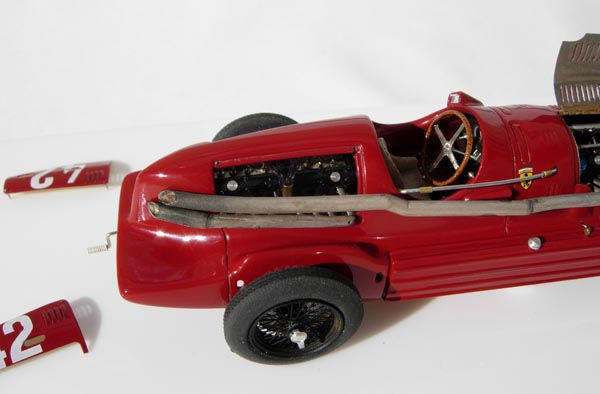
One-off, 1:43-Scale, Fully-Opening, Hand-built Model

One-off, 1:43-Scale, Super-detailed, Fully-opening, Hand-built Model of the Alfa Romeo P2, Winner Targa Florio 1930
This one-off model of the P2 is the winner of the 1930 Targa Florio, #30, driven by Achille Varzi. I find the car interesting not just because it was the winner of the race in an epic battle with Louis Chiron in a Bugatti (the victory went to Varzi by only 1 Hour and 48 minutes after almost seven hours of racing), but also because of the very unusual position of the spare wheel.
I also particularly liked the story that, during the last, frenzied lap, desperately trying to keep ahead of second-placed Chiron, Varzi got his mechanic to refuel the car from a can whilst still racing. Inevitably fuel was spilt and some splashed onto the hot exhaust, setting the rear of the car alight, so that flames were licking dangerously around the car. His mechanic had to use his seat cushion to put out the flames, but despite this close call, Varzi won the race.
The prototype was not based on a kit, but was completely scratch-built my me using Evergreen Plasticard, resin and brass. The various parts of the prototype were used to cast the body and other parts of the model, and to make the specially-commissioned photo-etched parts. The completed model was was presented for the first time at Retromobile 2013 in Paris.

One-off, 1:43-Scale, Fully-Opening, Hand-built Model

One-off, 1:43-Scale, Fully-Opening, Hand-built Model

One-off, 1:43-Scale, Fully-Opening, Hand-built Model

One-off, 1:43-Scale, Fully-Opening, Hand-built Model

One-off, 1:43-Scale, Super-detailed, Fully-opening, Hand-built Model of the Alfa Romeo P3, Winner of the 1935 German Grand Prix
This version of the P3 is the winner of the 1935 German Grand Prix driven by the Italian legend, Tazio Nuvolari. In a thrilling race with driving conditions made very difficult by wet weather, Nuvolari stormed over the finishing line in front of a crowd of an estimated 300,000 Germans, including many high-ranking Nazi officials, who were expecting an easy German victory. Their expectations were understandable as there were no less than seven German drivers competing in the more powerful German ’Silver Arrows’ of Mercedes and Auto Union. But Nuvolari showed his superior skills by coming back from behind and took the lead on the final lap to claim victory by more than 2 minutes ahead of 2nd-placed Hans Stuck in an Auto Union.
The prototype of the model was not based on a kit, but was completely scratch-built my me using brass, resin and Evegreen Plasticard. The various parts of the prototype were used to cast the body and other parts of the model, and to make the specially-commissioned photo-etched parts.
The model was finished in December 2016 and was on show during Retromobile 2017.

One-off, 1:43-Scale, Fully-Opening, Hand-built Model

One-off, 1:43-Scale, Fully-Opening, Hand-built Model

One-off, 1:43-Scale, Fully-Opening, Hand-built Model

One-off, 1:43-Scale, Fully-Opening, Hand-built Model

One-off, 1:43-Scale, Super-detailed, Fully-opening, Hand-built Model of the Auto Union Type A, Winner of the 1934 German Grand Prix
This one-off model is of the Auto Union Type A, winner of the 1934 German Grand Prix at the Nürburgring. It was driven by Hans Stuck, and was a significant win for the Auto Union partnership, not just because it was their first Grand Prix victory, but it was on German soil and they had beaten the omnipresent Mercedes team.
The car was designed by Ferdinand Porsche and Adolf Rosenberg and was both innovative and unconventional for the time, largely because it was a mid-engined race car.
In the beginning the model was to be based on an MCM kit, but after spending some time working with the kit I decided to merely use it as a basic template for the prototype to provide me with some of the dimensions of the bodywork. Therefore the model has been completely rebuilt either from scratch by me using brass, aluminium and Evergreen Plasticard, or from specially-commissioned photo-etched parts that I have designed. As a result none of the original kit remained as I felt this was the best way to ensure that the model would have the highest level of detail and quality.
The photographs show the development of the model from mid 2011 up until it was completed in early 2012.
The model was presented for the first time at Retromobile 2012 in Paris.

One-off, 1:43-Scale, Fully-Opening, Scratch-built Model

One-off, 1:43-Scale, Fully-Opening, Scratch-built Model

One-off, 1:43-Scale, Fully-Opening, Scratch-built Model

One-off, 1:43-Scale, Fully-Opening, Scratch-built Model

One-off, 1:43-Scale, Super-detailed, Fully-opening, Hand-built Model of the Auto Union Type C, Winner of the 1936 German Grand Prix
This one-off model is of the Auto Union Type C, winner of the 1936 German Grand Prix at the Nürburgring. It was driven by Bernd Rosemeyer who would go on to become European champion, the only time Auto Union achieved this honour.
The Type C model is not dissimilar to the Type A models that I have made, however this model was entirely scratch-built.
The chassis underside and frame were made from brass. All parts of the bodywork were scratch-built in brass, resin or aluminium. For example the front and rear noses were cast in resin, whereas the engine cover, with each louvred opening individually cut, was made from brass. This engine cover differs from the one on the Type A, as it does not have a hinged opening but the engine is accessed by completely removing the cover which is one piece and was made from three brass parts soldered together. As on the real car, the various parts of the bodywork on the model are held in place using real rivets.
The various parts of the front & rear suspension were scratch-built from turned brass and aluminium, as were the peripheral parts of the engine. The engine itself was made from scratch in brass and resin. The oil and water tanks were made from aluminium. Finally, the spring valves were individually made in 3 parts.
The model was finished in June 2014.

One-off, 1:43-Scale, Fully-Opening, Scratch-built Model

One-off, 1:43-Scale, Fully-Opening, Scratch-built Model

One-off, 1:43-Scale, Fully-Opening, Scratch-built Model

One-off, 1:43-Scale, Fully-Opening, Scratch-built Model

One-off, 1:43-Scale, Super-detailed, Scratch-built, Fully-opening Model of the Ferrari 330 TRI, Winner Le Mans 1962
The 330 TRI was driven to victory at the 1962 24 Hours of Le Mans by Phil Hill and Olivier Gendebien, and in doing so became the last front-engined car to win the race overall. Two other notable achievements from the race are that Hill and Gendebien were the first co-drivers to win the race three times, and Gendebien was the first four-time winner of the race.
This model is a my first fully-opening, scratch-built model for some time. I have used my own, scratch-built prototype to form and solder the bodywork in brass. The scratch-built chassis-frame has also been made using soldered brass tube and sheet. I wanted to use brass as the material is thin enough to create a very fine and realistic body, which will fit perfectly over the chassis frame. As fine sheets of brass are also very strong, it's possible to create bodywork that is more to scale than if using other, thicker materials.
The model has fully opening doors, and front and rear covers for the engine, fuel tank and spare wheel. These covers have also been made from brass sheet, as have the aerodynamic roll hoop, rear spoiler, fuel and oil flaps, and the various air vents.
I used the Renaissance TR engine as a base for this engine, and added various scratch-built parts in plasticard and turned aluminium, and added various fuel lines and cables such as the spark plug wires. Individual rivets have been added to the bodywork, and there are scratch-built tyre valves in turned aluminium. The windscreen has also been entirely scratch-built with the use of wire, rather than a decal, to create the special windscreen particular to the Le Mans version of the 330 TRI. The rear fuel tank has been scratch-built in plasticard and painted to resemble aluminium.
The photographs shows the development of the model from the very early work in the spring of 2021 up until completion in September 2021.
The model was on display at Retromobile 2022.

One-off, 1:43-Scale, Fully-Opening, Scratch-built Model

One-off, 1:43-Scale, Fully-Opening, Scratch-built Model

One-off, 1:43-Scale, Fully-Opening, Scratch-built Model

One-off, 1:43-Scale, Fully-Opening, Scratch-built Modeluilt Model

One-off, 1:43-Scale, Scratch-built Model of the Ferrari 612P from the 1968 Can-Am Challenge Cup, Las Vegas Stardust Raceway
The model of the Ferrari 612P, chassis #0866 is a unique, one-off, all-opening, scratch-built model from LP Creation, which was built using many of the same techniques that were developed during the making of the Maserati ’Birdcage’. Like the ’Birdcage’, this model resembles as near-as-possible the car that took part in the race.
Ferrari entered their only car in the race with Chris Amon at the wheel. Unfortunately the car was plagued with problems, even during practice, but managed to quality in 9th place. Despite this, the car only made it to the first turn before dropping out when sand jammed the throttle slides.
The three main sections of the bodywork were all made fom 0.15mm brass, each individual pieced moulded and shaped around resin casts before being soldered together. The resin casts were made especially by LP Creation. The distinctive Can-Am rear wing was also made from 0.15mm brass.
The central section of the bodywork was then attached to the chassis frame, which was made from various lengths of soldered brass tubing, before the internal workings of the car were fitted in place. The front and rear sections of the body are fully removable.
All the internal and external workings of the model - including the engine, suspension, carburettors, exhaust, cooling system, hinges and connections - were built from scratch using plastic, resin, aluminium and brass.
The finished car was presented for the first time at Retromobile 2007.

One-off, 1:43-Scale, Fully-Opening, Scratch-built Model

One-off, 1:43-Scale, Fully-Opening, Scratch-built Model

One-off, 1:43-Scale, Fully-Opening, Scratch-built Model

One-off, 1:43-Scale, Fully-Opening, Scratch-built Model

One-off, 1:43-Scale, Super-detailed, Opening, Hand-built Model of the Ferrari Dino 206 GT, Sebring 1969
This one-off model of the Ferrari Dino 206 GT chassis number 00306 was built using an AMR kit.
I used the AMR kit of this particular version of the 206 GT (a.k.a. 246 GT), but as this was not an opening kit, I had to make various changes and add new parts to create an opening model of the car from Sebring 1969.
To create an opening model it was necessary to create new doors, two new boot lids, a new bonnet lid, and all their hinges. All these parts have been scratch-built in brass. It was also necessary to create a scratch-built engine. The rest of the parts are those supplied with the kit.
The 206 GT was entered by NART in the 1969 12 Hours of Sebring, and was driven by the Americans Sam Posey and Ron Dini. Ricardo Rodrigues was also due to drive, but did not start. The car finished in 36th place.
This was a one-off commission which was finished in late 2019. It was on display at Retromobile 2020.

One-off, 1:43-Scale, Opening, Hand-built Model

One-off, 1:43-Scale, Opening, Hand-built Model

One-off, 1:43-Scale, Opening, Hand-built Model

One-off, 1:43-Scale, Opening, Hand-built Model

One-off, 1:43-Scale, All-Opening & Closing, Scratch-built Model of the Ferrari Dino 246 F1, Winner of the 1958 French Grand Prix
This 1:43-scale, one-off, scratch-built model of the Ferrari Dino 246 F1 was presented for the first time at Retromobile 2011 in Paris. It was the first super-detailed, all-opening, brass model made for some time, and had a greater level of detail than previous scratch-built models (as seen in the Archive Gallery) and featured many specially-made parts never before seen on a model by Pierre Laugier. The model could be fully closed.
The 1958 Grand Prix de l’A.C.F. (French Grand Prix) took place at Reims and marked the first victory of the Ferrari Dino 246 F1, and the first F1 win for a V6 engined car (it used a 2417cc Dino V6 engine with a 65° angle). Driven by Mike Hawthorn, car #4 lead from pole and remained there throughout the whole race, beating the course record with an average speed of 206 km/h. Whilst this was Hawthorn’s only win of the season, he went on to become World Champion that year, beating Stirling Moss by only one point, having secured 5 second places during the season.
The first element to be made was the frame from various sizes of brass tubing soldered together. The next elements, which were scratch-made in brass, were the rear suspension and de Dion axle. Note the photos that show some parts of the suspension and rear axel already soldered to the frame, together with the brake drums. Some of the parts for the suspension and axle worth highlighting include the transverse upper leaf springs, the rollers for the leaf springs, and the transverse location guide plate, fork and longitudinal radius arms for the axle.
Work on the model continued during the first 6 months of 2010. Those months were devoted to building the all-scratch engine and the various parts of the all-brass body. After that it was a question of painting the model and putting together all the various parts.
The photos show the finished model both fully opened and completely closed.
The model was exhibited for the first time as a "Work in Progress" at Retromobile 2009, and then again at Retromobile 2010. As already mentioned, the finished model was presented at Retromobile in Paris in February 2011.

One-off, 1:43-Scale, All-Opening & Closing, Scratch-built Model

One-off, 1:43-Scale, All-Opening & Closing, Scratch-built Model

One-off, 1:43-Scale, All-Opening & Closing, Scratch-built Model

One-off, 1:43-Scale, All-Opening & Closing, Scratch-built Model

One-off, 1:43-Scale, Scratch-built Model of the Lancia D50, 1955 Monaco Grand Prix
This Lancia D50 was driven by Ascari at the 1955 Monaco Grand Prix where he famously crashed it into the harbour. Sadly it was the great champion’s last race as he died a few days later testing at Monza.
This scratch-built, unique model was presented at Retromobile 2006 in Paris. Like other recent, scratch-built models by LP Creation, everything from the chassis frame, internal workings of the car and the bodywork were individually hand-made specially for the model.
The two side tanks, which are such a unique feature of this car, were made from fine sheets of 0.15mm brass, and each one has more than 120 hand-made rivets individually inserted into specially-drilled holes. The rest of the bodywork - like all the one-off models from LP Creation - was also made from 0.15mm brass sheets. The various apertures and vents were each individually cut and the pieces soldered together before being attached to the chassis frame.
The front and rear sections of the body are fully removable so that the engine and other internal workings of the car can be seen. All the internal and external workings of the model - from the carburettors, the exhaust, the cooling system, the engine, suspension, hinges, even the smallest rivets - were built from scratch using brass, aluminium, resin and plastic.

One-off, 1:43-Scale, Fully-Opening, Scratch-built Model

One-off, 1:43-Scale, Fully-Opening, Scratch-built Model

One-off, 1:43-Scale, Fully-Opening, Scratch-built Model

One-off, 1:43-Scale, Fully-Opening, Scratch-built Model

One-off, 1:43-Scale, Scratch-built Model of the Maserati ’Birdcage’ Tipo 63 from the 1961 12 Hours of Sebring
The Maserati Tipo 63 Birdcage, chassis #63.006 SWB, was a unique, one-off, all-opening, scratch-built model from LP Creation that took almost two years to make. The intention was to make a model car that would as close-as-possible resemble the real race car at Sebring.
The car was entered by Team Camoradi at the 12 Hours of Sebring in March 1961. Driven by Masten Gregory and Lucky Casner, the car did not finish the race, as it suffered with a collapsed rear suspension.
After the initial research on the original car and the drawing to scale of a working plan, the build really started with the bonnet, which was made from three individual pieces of 0.15mm brass moulded to shape with a hammer around a resin cast. The pieces were then soldered together and additional apertures for the radiator and the lights were cut out. All the resin casts used for the model were specifically cast by LP Creation.
The remaining parts of the bodywork were also made from 0.15mm brass, including the surround for the windscreen, all doors and opening panel and covers, and the rear wings. Just the rear body took three months to get to the stage where it was soldered together.
The ’Birdcage’ frame was built by soldering together 0.3mm, 04.mm and 0.5mm tubular brass. Lateral tanks in cast resin were then attached. Four prototype frames were made over a six-month period before the final frame was constructed. It took over one year to get to the stage of having a brass body to fit over the tubular frame.
Over the following year the various other parts of the model were built, including the engine and gear box, the seats, hinges and other internal workings of the car. All were built from scratch using plastic, resin, aluminium and brass.
Once painted and decorated, the model was finally complete and presented for the first time at Retromobile 2006 in Paris.
It would not have been possible for Pierre Laugier to make the car without the kind assistance of renowned Maserati expert, Willem Oosthoek.

One-off, 1:43-Scale, Fully-Opening, Scratch-built Model

One-off, 1:43-Scale, Fully-Opening, Scratch-built Model

One-off, 1:43-Scale, Fully-Opening, Scratch-built Model

One-off, 1:43-Scale, Fully-Opening, Scratch-built Model

One-off, 1:43-Scale, Super-detailed, Fully-opening, Hand-built Model of the Mercedes-Benz W154, Winner of the 1939 German Grand Prix
This one-off, fully-opening, scratch-built model in brass is of the Mercedes-Benz W154, winner of the 1939 German Grand Prix held at the Nürburgring on 23 July. It was driven by the German driver, Rudolf Caracciola, who had won the European championship an unsurpassed three times in 1935, 1937, and 1938. He also holds the unbeaten record of six wins of the German Grand Prix. The 1939 European champion was never officially declared as the Second World War broke out soon after the final race in Switzerland.
The work-in-progress was first shown during Retromobile 2017, and subsequently at Retromobile 2018. The model was completed in July 2018.

One-off, 1:43-Scale, Fully-Opening, Hand-built Model

One-off, 1:43-Scale, Fully-Opening, Hand-built Model

One-off, 1:43-Scale, Fully-Opening, Hand-built Model

One-off, 1:43-Scale, Fully-Opening, Hand-built Model